What Are the Safety Risks of 3D Printed Guns?
Are you concerned about the safety risks associated with 3D printed guns? Many people struggle with understanding how dangerous these DIY firearms can be. You’re not alone—there’s a lot of confusion around their performance and security.
3D printed guns pose serious safety risks because they often have unpredictable performance, structural weaknesses, and material durability issues.
Design flaws and poor-quality materials can cause malfunctions like misfires, jams, or even explosions.
Plus, their lack of regulation and detection makes them easy to produce and hide. This raises concerns about safety and enforcement.
If you want to understand how these risks can be minimized and what safety measures are essential, there’s more you need to investigate.
Key Takeaways
- Design flaws and lack of testing can cause malfunctions like misfires or explosions.
- Using weak or degraded materials increases the risk of cracking, melting, or structural failure.
- Without quality control standards, the performance becomes unpredictable, creating safety hazards.
- The absence of regulatory oversight means unsafe firearms can be produced and used illegally.
- Difficulties in detection and tracing make it harder for law enforcement and can lead to more illegal use.
What Are 3D Printed Guns and How Do They Work?
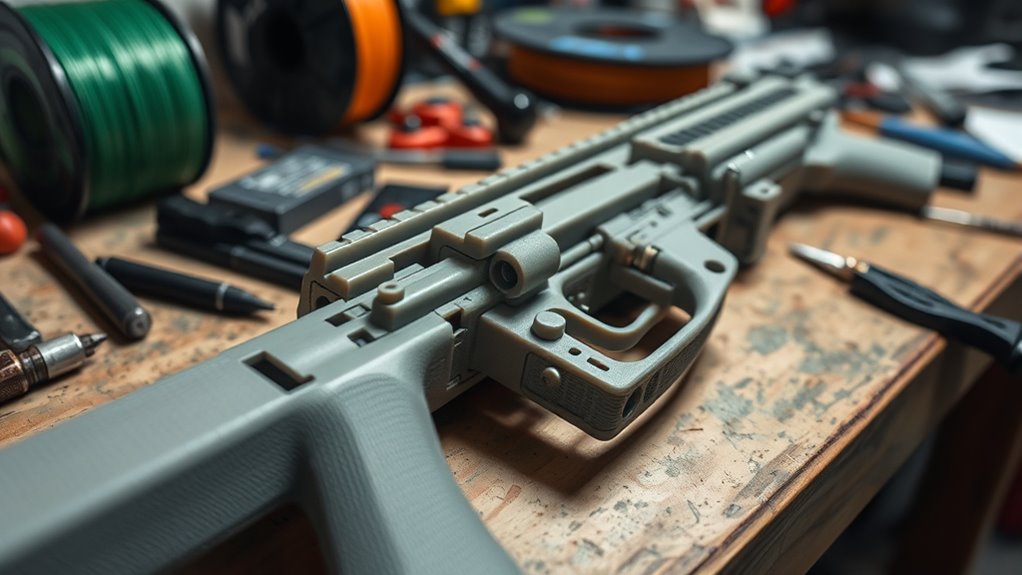
3D printed guns are firearms made using additive manufacturing technology, which builds objects layer by layer from digital designs. These guns are created by following specific design principles to ensure parts fit together and work properly.
The design process involves creating a detailed digital blueprint, often with CAD software. Once the design is ready, the 3D printer deposits material, like plastic or metal, exactly according to the model.
This process allows for quick production and customization, making it easier to create firearm parts rapidly. The key to functional 3D printed guns is designing each piece for strength, durability, and safety.
While the technology offers flexibility, it also requires careful attention to manufacturing details. Ensuring each layer fuses correctly is crucial for the finished gun to perform reliably.
Why Are 3D Printed Guns Considered Unsafe?
3D printed guns are considered unsafe mainly because the materials used typically aren’t very durable. That means they can break or fail when you actually fire them, which is obviously pretty risky. Their performance can be all over the place, so you can never really count on them to work reliably, and that unpredictability can lead to dangerous situations. Plus, since there’s no strict quality control, you can’t be sure they’re safe or consistent every time you use them.
Material Durability Concerns
Because the materials used in printing guns often lack the strength and resilience of traditional firearm components, they can fail unexpectedly during use. This mainly happens because of limitations in material choice and manufacturing processes.
3D printed gun parts are usually made from plastics or resins that can degrade or crack under stress, which raises safety concerns. Poor-quality materials and inconsistent manufacturing can cause sudden failures like cracking or melting.
| Material Type | Strength and Resilience | Common Manufacturing Issues |
|---|---|---|
| ABS Plastic | Moderate | Warping during printing |
| Nylon | Good | Inconsistent layering |
| PETG | High | Poor adhesion |
| Resin | Varies | Brittleness |
Unpredictable Performance Risks
Unpredictable performance is a major safety concern with printed guns because their parts can behave unexpectedly under stress. Design flaws in 3D printed firearms often create weak points that might fail during use, risking injury or malfunction.
Unlike factory-made guns, these weapons don’t go through rigorous testing. This means their reliability is uncertain, and you can’t be sure how materials will react after repeated firing or under high pressure.
This unpredictability can lead to the gun exploding, jamming, or misfiring at critical moments. Without standardized testing, it’s hard to assess safety and performance, increasing risks for users.
Lack of Quality Control
The absence of standardized quality control processes in 3D printed guns makes them inherently unsafe. Unlike traditional firearms, which follow strict design standards and regulated manufacturing processes, 3D printed guns often lack consistency.
Variations in materials, printer calibration, and printing techniques can lead to flawed parts that may fail during use. Without proper quality control, you can’t be sure if each gun meets safety requirements or structural integrity.
This increases the risk of catastrophic malfunctions, such as barrel rupture or misfiring. Because these guns are produced outside regulated environments, there’s little assurance of their reliability.
Ultimately, the lack of quality control undermines safety, making 3D printed guns unpredictable and dangerous to operate.
What Safety Risks Do 3D Printed Guns Present?
3D printed guns can be pretty risky for safety, mainly because the materials used aren’t always reliable when under pressure. They might break or malfunction unexpectedly, which can be really dangerous.
Then there’s the issue of how they fire. Since these guns often lack the usual safety features, they can misfire or explode, leading to injuries or damage. Without proper rules and oversight, there’s a higher chance that these guns will be unsafe or even fall into the wrong hands and be misused.
Material Durability Concerns
Since the materials used in 3D printing might not have the same strength and heat resistance as traditional firearm parts, they can pose serious safety risks. Choosing the right material is key because weaker plastics can crack or deform during use, increasing the chance of failure.
Different printing techniques also affect durability. Some methods create less dense or uneven layers, which can reduce overall strength. If you pick the wrong materials or unreliable printing methods, your 3D printed gun might not handle firing pressures properly.
This can lead to malfunctions or even catastrophic failures. Even if the firearm works at first, it could break unexpectedly, putting you or others at risk. So, proper material choice and precise printing are essential to keep safety hazards at bay.
Unpredictable Firing Risks
Because of their DIY nature, 3D printed guns can fire unpredictably, posing serious safety risks. Malfunctions can happen because these firearms don’t follow consistent manufacturing standards, increasing the chance of misfires or accidental discharges.
You might experience sudden barrel blockages or double fires, which can threaten your safety and others nearby. While some safety improvements aim to boost reliability, they don’t eliminate all the risks linked to unpredictable firing.
Key risks include:
- Sudden misfires that can cause injuries
- Unexpected double or multiple shots
- Structural failures during firing
- Difficulty spotting safety issues before use
These hazards show that without proper regulation, 3D printed guns are inherently less reliable and more dangerous.
Lack of Regulatory Oversight
Without proper regulation, 3D printed guns pose serious safety risks because there are no standard manufacturing or quality control procedures to ensure their reliability.
Regulatory challenges make it hard to monitor or restrict how these firearms are produced and distributed.
Oversight limitations mean individuals can easily bypass existing laws, creating a dangerous gap in control.
Since these guns are often printed at home or small facilities, authorities can’t verify safety standards or guarantee consistent quality.
This lack of oversight increases the chances of malfunctions, misfires, or even catastrophic failures.
Without strict regulations, we could see unsafe, untested guns flooding the market, putting everyone at greater risk.
How Material Quality Affects the Durability and Safety of 3D Printed Guns
The quality of the materials used in 3D printing directly impacts the gun’s durability and safety. Poor material sourcing or low-grade filaments can cause parts to weaken or fail unexpectedly.
To guarantee safety, you need to pay attention to design standards and select materials that meet strict quality benchmarks. Inferior plastics or improperly sourced metals may crack or deform under stress, increasing risk during use.
High-quality materials, on the other hand, provide better resistance to wear, heat, and mechanical stress. You should consider factors like tensile strength, thermal stability, and chemical resistance when choosing materials.
Moreover, understanding the specifications for each material helps you avoid safety hazards caused by subpar components. Proper material sourcing and adherence to design standards are essential to make 3D printed guns safer and more durable, reducing the risk of catastrophic failures during operation.
What Are the Risks of Structural Failures and Mechanical Malfunctions?
Using subpar materials or ignoring proper design standards increases the risk of structural failures and mechanical malfunctions in 3D printed guns. Poor material choices can weaken the gun’s structural integrity, making parts more likely to crack or break under stress.
If the design isn’t carefully tested, critical components might fail unexpectedly. This can lead to injuries or malfunctions during use. Mechanical reliability is key for safe operation, but weak components or inadequate calibration can cause jams, misfires, or even catastrophic failure.
Since 3D printed guns often lack the strict quality control of traditional manufacturing, small flaws can turn into serious safety hazards. You might not notice these issues until it’s too late, especially when the gun is under pressure or firing repeatedly.
Choosing strong, durable materials and following proper design standards can help improve safety. However, the risks of structural failure and mechanical malfunction are still significant concerns.
Can Authorities Detect and Trace 3D Printed Guns?
Can authorities effectively detect and trace 3D printed guns? Detection methods face big challenges because these weapons often lack serial numbers or markings that can identify them.
Law enforcement uses techniques like ballistic analysis and forensic exams, but tracing these guns is still tough. 3D printed guns can be made from plastics and other materials that are hard to detect with traditional methods.
Plus, the digital files used to print these guns can be shared anonymously or deleted, making tracking even harder. Authorities are trying to improve this by investigating digital forensics, like tracking CAD files or online activity.
However, the decentralized nature of 3D printing keeps creating obstacles. The main issues are limited physical identifiers, difficulties analyzing plastics, trouble tracking digital blueprints, and new printing tech that outpaces detection tools.
Why Are 3D Printed Guns Difficult to Regulate and Control?
You might find it tough to regulate 3D printed guns because they’re often untraceable. That makes it really hard for authorities to track where they come from or who made them. Plus, with how quickly technology is advancing, it’s easier than ever for people to print guns at home, and laws just can’t keep up with these rapid changes. All of this adds up to some pretty big challenges when it comes to controlling these weapons effectively.
Untraceable Firearms Challenges
Because 3D printed guns lack serial numbers and are often made from easily accessible digital blueprints, regulating and controlling them becomes extremely tough. They can be produced anywhere, bypassing traditional tracking systems.
Digital blueprints are simple to share online, and anyone with basic skills can print guns at home without much oversight. This makes enforcement nearly impossible and complicates criminal investigations and regulation efforts.
The absence of identifiable markings on these guns makes tracking even harder for law enforcement. Existing laws struggle to keep up with how quickly this technology is advancing.
All these factors combined make controlling 3D printed guns a big challenge, fueling illegal markets and raising safety concerns. Their easy access and production pose a serious threat to firearm regulation efforts.
Rapid Technological Advancements
Advancements in 3D printing technology have been happening really fast, making it harder for regulations to keep up. These tech changes mean that anyone with a 3D printer can now produce firearms at home, avoiding traditional controls.
This ease of copying gun parts or even entire weapons challenges existing laws, creating loopholes that are tough to close. Ethical questions also come up about who’s responsible and how safe these printable guns really are.
As technology advances, regulations struggle to adapt quickly enough, leaving gaps that bad actors can exploit. This rapid progress highlights the urgent need for updated policies that balance innovation with public safety.
How Do Illegal Users Make and Use 3D Printed Guns?
How do illegal users produce and deploy 3D printed guns? They often make firearms illegally at home, bypassing laws and regulations. Their motivations include avoiding detection and getting weapons without proper licenses.
To do this, they usually:
- Download blueprints from underground online sources, which risks getting caught.
- Use cheap 3D printers, sometimes modified to make stronger guns.
- Put together guns quickly and often skip safety steps.
- Hide or sell these firearms secretly, making it harder for law enforcement to find them.
These actions make it easier for bad actors to get guns, increasing safety risks. The simple access and anonymity of online networks help fuel illegal 3D printed gun activities. Criminals and unauthorized users take advantage of these loopholes.
Illegal online access enables criminals to easily obtain and produce 3D printed guns, escalating safety threats.
This shows the urgent need for better regulation and monitoring to stop misuse and keep everyone safe.
What Are Best Practices to Minimize Risks When Making 3D Printed Guns?
To minimize risks when making 3D printed guns, it’s important to follow strict safety protocols and legal guidelines throughout the process. Prioritize ethical design by creating models that are safe and avoid features that could cause harm.
Always test printed components thoroughly to ensure they can handle firing stresses and won’t unexpectedly fail. Educate yourself about the legal restrictions in your jurisdiction to prevent illegal manufacturing or distribution.
Focus on community responsibility by considering the broader impact of your work—avoid designs that could be easily misused. Use quality materials suited for firearm parts and follow recommended printing settings for accuracy and durability.
Document your process carefully to maintain transparency and accountability. By following these best practices, you help reduce safety risks, promote responsible innovation, and create a safer environment for everyone involved in 3D printed gun production.
What Legislation and Technology Can Help Improve Safety and Detection?
While technology and legislation alone can’t eliminate all risks associated with 3D printed guns, they play a crucial role in improving safety and detection.
Legislative measures can restrict access to blueprints, enforce licensing, and impose penalties for illegal manufacturing. These laws can deter misuse and limit availability to unauthorized users.
Technological advancements also help by enabling better detection methods, such as advanced scanners and 3D printer identification tools that recognize unauthorized prints.
Furthermore, digital watermarking and traceability features embedded in designs can help authorities track and verify firearms.
Combining these approaches creates a layered defense against illegal production and distribution.
To improve safety, support policies that regulate 3D printing technology and adopt advanced detection systems.
This integrated approach strengthens security, discourages misuse, and promotes responsible innovation.
Ultimately, proactive legislation paired with technological progress forms the backbone of safer, more controlled 3D printed firearm management.
Frequently Asked Questions
Are 3D Printed Guns More Prone to Accidental Discharge?
Yes, 3D printed guns are more prone to accidental discharge because their trigger mechanisms may not be as reliable or well-designed as traditional firearms.
Material quality plays a big role here. Lower-quality plastics can weaken over time, which increases the risk of misfires or unintentional firing.
Without proper testing and safety features, these guns can be unpredictable and dangerous to handle.
How Does the Design Complexity Affect Safety in 3D Printed Guns?
Design complexity directly impacts safety in 3D printed guns because it introduces design limitations that can compromise structural integrity. When you create intricate designs, you risk weak points that might cause failure during use, leading to accidental discharges or breakage.
Simplifying designs helps guarantee better structural integrity, reducing safety hazards. You should prioritize straightforward, robust designs to minimize risks associated with complex, fragile 3D printed gun components.
Can 3D Printed Guns Be Easily Modified or Customized?
Yes, 3D printed guns can be easily modified or customized because of their design flexibility. You can change the shape, size, or features to match your preferences or needs.
Making user modifications is pretty straightforward, so you can quickly personalize or improve the gun. But keep in mind, these changes can also pose safety risks if not properly tested.
Altered designs might weaken the gun’s structure or affect how well it works, which could lead to potential hazards.
What Are the Long-Term Durability Concerns for 3D Printed Firearms?
You should be concerned about long-term durability, as material fatigue can weaken 3D printed firearms over time, especially with repeated use.
The structural integrity of these guns may degrade faster than traditional metal counterparts, increasing the risk of failure during firing.
Poor-quality filament or inconsistent printing processes can worsen these issues, making it unsafe to rely on a 3D printed firearm for sustained use.
How Do 3D Printed Guns Impact Overall Gun Safety Regulations?
Like Pandora’s box opening, 3D printed guns challenge gun safety regulations by creating new regulatory hurdles and enforcement problems.
It becomes harder to track and control firearms made at home, which can bypass traditional laws.
This technological shift calls for updated laws and stronger enforcement efforts.
Without quick action, the risk of unregulated firearms falling into the wrong hands grows.
This threatens public safety and makes it more difficult to control gun proliferation.
Conclusion
To stay safe, remember that 3D printed guns come with serious risks. These include structural failures and legal loopholes that can cause harm.
Just like the invention of the wheel revolutionized transportation, 3D printing is changing how firearms are accessed. But it’s not without dangers.
Be cautious and stay informed about regulations and best practices. Only through responsible use and smart policies can we prevent 3D printed guns from becoming a modern-day Pandora’s box.
Stay vigilant—your safety depends on it, especially when it comes to the safety risks of 3D printed guns.