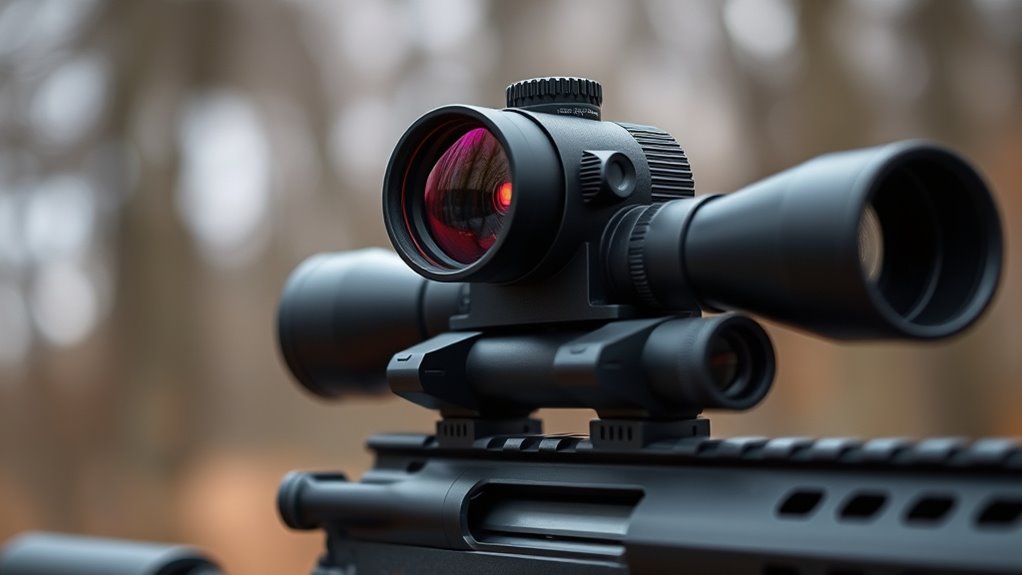
Sight Your Red Dot Scope Without Shooting
Many shooters know the frustration of trying to sight in a red dot scope, especially when you don’t want to go to the range every time. It can be tricky to get everything aligned perfectly without firing a shot. You’re not alone—this is a common challenge for both beginners and seasoned marksmen.
To sight in your red dot scope without shooting, start with a bore sighter for quick initial alignment. Just match the reticle with your barrel’s axis to get close.
Then, set up a stable rest and aim at a high-contrast target at your preferred distance.
Fine-tune the scope’s adjustments by imagining where your shots would hit. Use a laser bore sighter or the scope’s adjustment dials to make small changes.
Keep your setup steady—if you keep exploring, you’ll learn how to perfect your zero even further.
Key Takeaways
- Use a bore sighter to line up the red dot scope with your firearm’s barrel before making any adjustments.
- Place your firearm on a stable rest and aim at a distant, high-contrast target for accurate alignment.
- Adjust the scope’s windage and elevation turrets based on the target alignment, all without firing.
- Verify the zero with a laser bore sighter to ensure everything is accurate.
- Finally, recheck and fine-tune the zero after initial adjustments by shooting at a target to confirm proper alignment.
Understanding How to Zero Your Red Dot Scope Without Firing
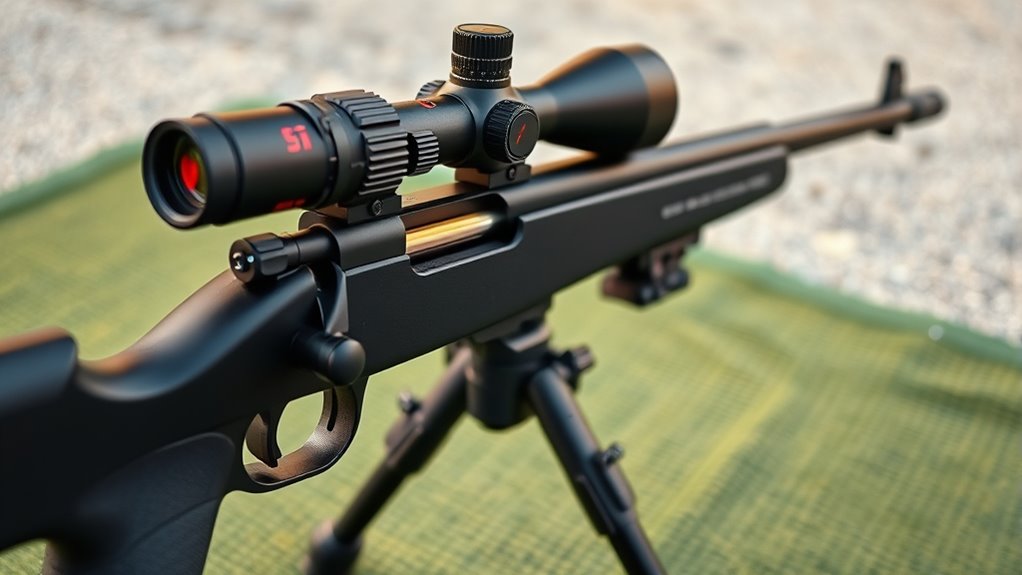
Zeroing your red dot scope without firing might seem tricky at first, but it’s totally doable with the right tools and techniques. One of the main advantages of a red dot is that you can make precise adjustments without live firing, making it safer and more convenient.
This means you can align your sight without using ammo, reducing wear on your firearm and avoiding noise or recoil that could throw off your adjustments. By using a target or zeroing paper, you can carefully move the red dot to match your desired point of impact.
This method allows you to fine-tune your scope’s alignment with minimal effort and risk. Once you’re happy with the zero, you can take your firearm to the range and verify your zero with live fire.
What Tools Do You Need for Non-Firing Zeroing?
To accurately adjust your red dot scope without firing, you’ll need a few essential tools that help simulate the shooting process. A tools checklist for non-firing zeroing includes a bore sighting device, a stable shooting rest or bipod, a target, and a marking pen.
The bore sighting tool is vital for aligning your scope with your barrel’s axis, providing a rough zero before fine-tuning. A stable rest guarantees your weapon stays steady during adjustments, preventing errors caused by movement.
A target allows you to visually assess your shot placement and make precise adjustments. Finally, a marking pen helps you record your shots and track progress.
These zeroing essentials streamline the process, reduce the need for multiple firing sessions, and confirm your scope is accurately zeroed even without firing a single round. With the right tools, you can achieve reliable zeroing efficiently and confidently.
How to Find a Stable Shooting Position
Looking for a stable shooting position? Well, the first thing you want to do is pick a solid support or a steady piece of ground—something that won’t wobble or shift. Once you’ve got that, focus on how your body is aligned. Make sure your shoulders, arms, and the firearm are all in a comfortable, balanced stance. It might feel a bit awkward at first, but that stable foundation is what keeps your shot steady and on target.
Choose Firm Support Base
Finding a firm support base is key for accurate shooting. A stable foundation keeps your support steady, helping you keep the red dot scope aligned without unnecessary movement.
When choosing your base materials, think about options like sandbags, bipods, or sturdy surfaces such as tables or rocks. These help absorb vibrations and create a steady platform, reducing wobble.
Use sandbags or bags filled with supportive materials for steady support.
Pick a bipod or tripod designed to stay stable during shooting.
Opt for solid, level surfaces like rocks, tables, or thick logs to keep things steady.
Maintain Proper Body Alignment
Position yourself comfortably and stand with your feet shoulder-width apart, keeping your body relaxed yet steady. Your posture is key to staying stable when sighting your red dot scope.
Use proper alignment techniques to make sure your body is lined up with the target and your support. Keep your shoulders relaxed and your spine straight, avoiding any twisting or leaning.
Your head should be positioned so your dominant eye naturally lines up with the scope without effort. Engage your core muscles to stay balanced and prevent unnecessary movement.
Consistent body alignment helps you hold your shot steady and reduces eye strain. Practice these techniques regularly to develop a natural, stable shooting position that improves accuracy without needing to shoot.
Preparing Your Target for Scope Zeroing
Before you start zeroing your scope, it’s really important to prepare your target correctly. You want a clear, stable target to ensure your adjustments are accurate. Picking the right target makes a big difference.
Choose something with high contrast and a defined center point so you can see your shots clearly. Also, make sure you know the exact distance you’ll be shooting from to match your scope’s settings.
A well-prepared target helps you spot your shots easily and makes fine-tuning much simpler. Use a sturdy, flat surface to prevent any movement or wobbling. Select a target with a bright, visible aiming point or bullseye.
Finally, mark or note the exact distance for accurate calibration. Taking these steps sets you up for a successful zeroing session.
How a Laser Bore Sighter Can Help Zero Your Red Dot
A laser bore sighter is a handy tool that helps you get your red dot scope aligned just right from the get-go. It makes the whole process of zeroing in much smoother and more accurate, so you’re not wasting time guessing or making endless adjustments.
Plus, it really speeds things up at the range. Instead of spending hours fiddling with your scope, you can get it close to perfect quickly, then fine-tune as needed. With a laser bore sighter, you can confidently zero your red dot every time, knowing you’re starting off on the right foot.
Precise Alignment Techniques
Using a laser bore sighter can really boost your chances of getting your red dot scope perfectly aligned when zeroing. It gives you a clear reference point for your adjustments and helps ensure your reticle is calibrated correctly.
To get the best optical clarity and precision, focus on a few key techniques:
- Align the laser directly with your bore to keep everything consistent during calibration.
- Use the reticle’s fine adjustments to center the laser point on your target, minimizing deviation.
- Double-check the laser’s position after your initial tweaks to make sure the scope’s reticle lines up perfectly with the bore’s point of aim.
These simple methods help you fine-tune your scope confidently, cut down on guesswork, and ensure your red dot is zeroed accurately for reliable shots.
Time-Saving Zeroing Method
Employing a laser bore sighter can really speed up the process of zeroing your red dot scope, saving you valuable time at the range. It lets you make adjustments without firing a shot, which is a huge time-saver.
By using the bore sighter, you can quickly get your red dot roughly centered on your target, making scope calibration more efficient. This method reduces the need for multiple live fire sessions, saving you ammo and frustration.
Once the laser shows proper alignment, you can fine-tune your scope adjustments to get that perfect zero. Overall, a laser bore sighter makes the whole process faster and more precise with minimal effort.
Adjusting Windage and Elevation for Better Accuracy
To improve your shot accuracy, you need to precisely adjust the windage and elevation settings on your red dot scope. Proper windage adjustments ensure your reticle lines up horizontally, helping you compensate for crosswinds or moving targets.
Adjust windage and elevation on your red dot scope for better accuracy and consistent hits.
Elevation tweaks control vertical alignment, which is crucial for hitting targets at different distances. Start by checking that your scope is mounted securely and that the lenses are clean, as loose mounts or dirty lenses can distort your sight picture.
Consider environmental factors like wind or lighting, both of which can impact your aiming. Regularly perform alignment checks to keep your accuracy consistent. Remember, reticle calibration is key for precise shots, so fine-tune both adjustments until your point of aim matches your hits.
Proper scope maintenance, including dusting and re-zeroing after adjustments, keeps your scope functioning well. Following these steps helps ensure your scope remains reliable, making your shots more accurate and consistent every time.
How to Confirm and Fine-Tune Your Scope Zero
Before heading out for a critical shot, it’s important to verify that your scope is properly zeroed. Start by inspecting your red dot for consistent optical clarity; any fogging or smudges can affect your accuracy.
Use a stable shooting rest or bench to aim at a target at a known distance. Check your point of impact against your reticle, and adjust the windage and elevation as needed.
Fine-tuning your scope zero involves small, incremental adjustments—usually a quarter or half MOA at a time—until your point of aim matches your point of impact.
Regular red dot maintenance guarantees the lens stays clean and clear, which is essential for accurate shot placement.
Common Mistakes to Avoid When Zeroing Without Firing
Zeroing your scope without firing can save time and ammo, but it also comes with some common pitfalls that can mess with your accuracy. One mistake people make is relying only on alternative methods without firing a shot to verify the zero, which can lead to inaccuracies.
Don’t assume that static measurements or simulations will match real shooting conditions perfectly. Environmental factors like wind and temperature can also affect your zero, even if you haven’t fired a shot.
Be cautious of these mistakes:
- Relying solely on mathematical calculations instead of testing with live fire
- Ignoring environmental influences that can impact your scope’s alignment
- Thinking you can get a perfect zero without making real shooting adjustments
Transitioning From Non-Firing Zero to Live Fire Testing
Before you jump into live fire testing, it’s a good idea to double-check your zero. You want to make sure your scope is still on point and matches your original zero setting. It’s all about making sure everything is accurate before you start firing live rounds.
Once you’re confident that your zero is right where it should be, go ahead and transition smoothly to live fire. This step is important because it allows you to see how your sight performs under real shooting conditions, helping you fine-tune if needed.
Ensuring Proper Zero Alignment
Shifting from a non-firing zero to live fire testing is a crucial step in making sure your red dot scope is properly aligned. To verify your zero, focus on precision when adjusting your scope and refine your aiming techniques.
Proper zero alignment guarantees your shots hit where you’re aiming, especially at different distances. Double-check your scope adjustments to match your target’s distance and your firearm’s ballistic profile.
Use consistent aiming techniques to keep your accuracy during adjustments. Finally, confirm your zero on the target and make small tweaks as needed to ensure everything is spot on.
Transitioning to Live Fire
Once your scope is dialed in on the target, it’s time to move from dry-fire exercises to live-fire testing. During this shift, focus on sighting techniques that verify your zero under real firing conditions.
Start with a controlled, precision shot at a known distance, then evaluate your shot groupings. Use your scope adjustments to fine-tune your zero if needed, accounting for any discrepancies.
Remember, live fire can reveal subtle shifts caused by recoil or your stance, so be prepared to make small, deliberate scope adjustments. Take your time, shoot multiple rounds, and verify your zero at different distances if possible.
This process ensures your red dot scope stays accurate, giving you confidence for upcoming shooting sessions.
Tips for Maintaining Your Red Dot Zero Over Time
To ensure your red dot scope stays zeroed over time, regular maintenance is key. Proper upkeep helps prevent drift and keeps your adjustments accurate.
Check the mounting screws regularly and tighten them if needed, because loose mounts can throw off your zero. Use adjustment techniques carefully; make small, incremental changes to avoid overcorrecting.
Keep the lens clean with a soft cloth to maintain clarity and visibility, which helps with precise shot placement. Store your scope in a cool, dry place to prevent moisture buildup that can affect internal parts.
Periodically verify your zero by shooting at a known distance and adjust if necessary. Remember, consistent checks and gentle adjustments are your best tools for maintaining your red dot zero over time.
- Regularly tighten mounting screws to prevent shifts
- Clean lenses with appropriate materials to ensure clarity
- Store your scope properly to avoid environmental damage
Frequently Asked Questions
Can Environmental Factors Affect Non-Firing Scope Zeroing Accuracy?
Environmental influences and atmospheric conditions can affect your red dot scope zeroing accuracy even without shooting. Changes in temperature, humidity, and air pressure can alter how your bullet travels, impacting where your shot lands.
Wind can also sway your shot’s trajectory. To improve precision, regularly check and adjust your scope in different conditions, understanding that environmental factors play a role in maintaining accurate zero without firing.
How Often Should I Re-Zero My Red Dot Scope Without Firing?
You should re-zero your red dot scope periodically, especially if you notice accuracy issues or environmental changes.
Use proper zeroing techniques and alignment methods, like adjusting the windage and elevation screws carefully, to keep your sighting precise.
Regularly check your scope’s alignment without firing by using target markers or calibration tools.
Doing this helps ensure your scope stays accurate over time and can save you from unnecessary shots.
Is It Possible to Zero a Red Dot Scope on Different Firearm Models?
Yes, you can zero a red dot scope on different firearm models, but it requires careful crosshair alignment and optical calibration for each firearm.
You’ll need to adjust the scope’s mounting and settings to match the specific firearm’s dimensions and ballistics. Keep in mind, each firearm may have slight differences, so rechecking and fine-tuning the scope’s zero guarantees accuracy for every firearm you use.
What Are the Signs That My Scope May Be Misaligned?
If your red dot scope is misaligned, you’ll notice your shots consistently drift off target, even after aiming carefully. It can be frustrating to hit your mark when things seem off.
Check if the dot appears off-center or if your point of impact doesn’t match your sight picture. These are common signs that your scope might need some attention.
Use scope alignment tips like ensuring the reticle is centered and making precise red dot adjustments. These small tweaks can make a big difference.
Regularly verifying and fine-tuning your scope helps maintain accuracy without shooting all over the place. It’s worth checking every now and then to keep things on point.
Can I Use a Smartphone App to Assist in Scope Zeroing?
Like Sherlock with his magnifying glass, you can use a smartphone app to help zero your red dot scope without shooting.
Many apps use your phone’s features like camera stabilization and digital reticles, making precise adjustments easier.
Compare different apps and look for ones with user-friendly interfaces and calibration tools.
While they won’t replace live fire, these tools can definitely improve your scope’s accuracy before hitting the range.
Conclusion
Now that you know how to zero your red dot scope without firing, you’re ready to save time and ammo while hitting your target more accurately.
With the right tools and techniques, you can confidently set your scope from a stable position, then verify and fine-tune it later.
So, why wait for the perfect shot when you can prepare perfectly beforehand? Isn’t that a smarter way to sight your red dot scope without shooting every time?